You may well have heard of the term Enneagram, but did you realise that this theory dates back to way before Christ and held a firm place in many a religious and spiritual belief. Back then the concept was known more as a discernment of spirits and was used for people to read one another, to determine good from bad and to deliver us from evil!
What it is…
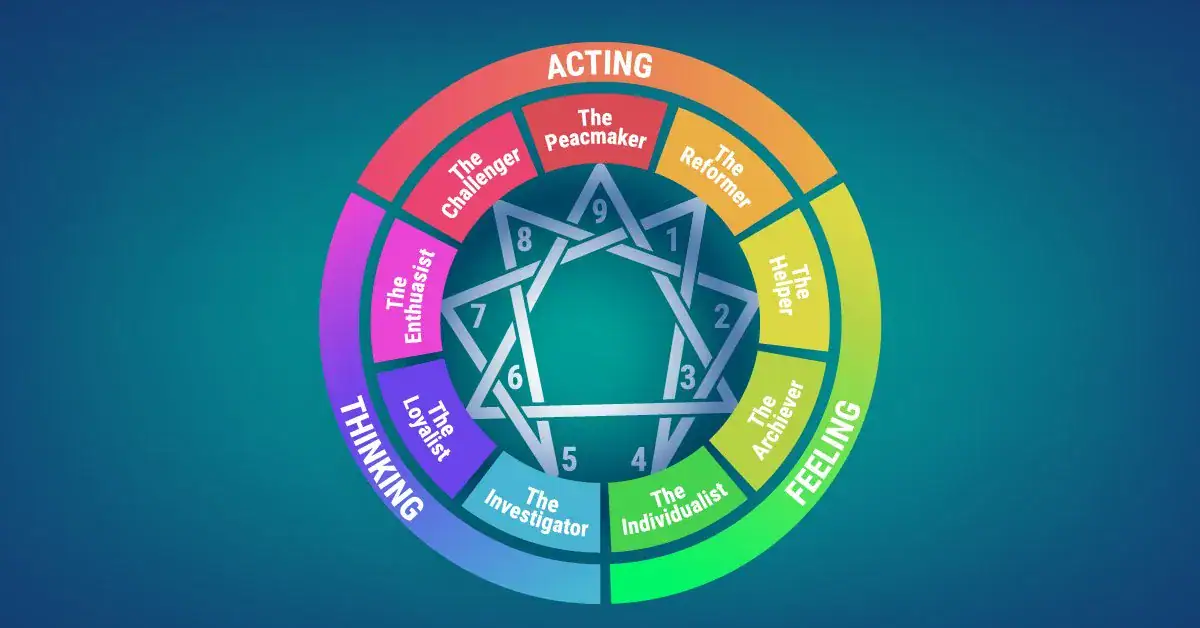
The Enneagram is a system made up of nine numbers which relate to personality types. These types describe how those who fall under the category do so, how they manage themselves, their emotions, their being. You may be familiar with the Enneagram diagram which marks out the nine personality types as points within a circle which also serves to display how the types are interconnected. The diagram features a circle surrounding an evenly spaced nine-pointed and numbered geometric symbol. Each person is said to connect to one of these nine numbered points which represents their life perception type, the number directly to the left or right of this number is called the wing which theories offer we can shift into from our original type. Each number, or type, on the enneagram is linked by a line to two other types – the first connection being a type you left behind, the second the type you may progress into in the future. These connections intensify the diagram and the potential outcomes as it now becomes more dynamic and malleable.
What it can mean…
Your type does not necessarily describe you exactly as you think you are, or want to be, but focusses more on the way your type perceives the world and those within it. Once we come to terms with, and understand, our personal enneagram we can begin to respect that our core belief may be somewhat limiting – this understanding may help us to broaden our horizons, perspective wise, and help us to approach life more openly and effectively.
And for others around us, understanding and knowing one another’s types can help us to better comprehend each other’s behaviour, actions and reactions. To know one another in this way can help us to see how another person might feel or is feeling under certain pressures. It can help to understand people’s response to stress, as well as learn a deeper feeling of empathy towards our fellow humans.
The Enneagrams Institute claims that the use of the model is for “personal self-knowledge and personality development, offering a powerful tool for self-mastery, conflict resolution, team dynamics, leadership and emotional intelligence. Because it identifies opportunities for development for each individual type, it has become widely used in areas such as counselling, psychotherapy, business development, parenting and education as well as aiding personal development, spiritual growth, relationships and even career development.”
The types…

The personality types are categorised under three headings, each with three types under its heading; Heart, Head and Body – heart types lead with and depend upon their emotions, are empathetic, and connect with the world via their feelings (hearts). Head types utilise their intellectual intelligence and body types lean on their instincts. The heart types consist of numbers two, three and four, head types are five, six and seven, and body, eight, nine and one. The following outlines a basic description of each type…
Heart types are…
Type 2, the giving type, those who want to be liked and will help others to find a way to belong. They need to feel a sense of belonging.
Caring, Interpersonal, Demonstrative, Generous, People-Pleasing, and Possessive.
Type 3 are driven and depend heavily on their perceived image. They desire success and adoration from others and can be very self-conscious as well as excellent.
Success-Oriented, Pragmatic, Adaptive, Excelling, Driven, and Image-Conscious.
Type 4 seek a deeper meaning to emotion, they crave uniqueness and authenticity as individuals.
Individualistic, Sensitive, Withdrawn, Expressive, Dramatic, Self-Absorbed, and Temperamental.
Head types are…
Type 5 are knowledge seekers. They need to know and understand logic and information to make sense of things.
Investigative, Intense, Cerebral, Perceptive, Innovative, Secretive, and Isolated.
Type 6 are the preparing type, especially for problems. They need safety and seek security in all they feel and do. They may be more inclined to worry or fear the worst.
Loyal, Committed, Security-Oriented, Engaging, Responsible, Anxious, and Suspicious.
Type 7 are thrill-seekers. Adventure is in their blood and they need a lot of entertaining to keep them occupied.
Enthusiastic, Busy, Fun-Loving, Spontaneous, Versatile, Distractible, and Scattered.
Body types are…
Type 8 are resilient and up for a challenge. They are strong and have natural power, with an innate ability to stand up for themselves and their beliefs.
Challenging, Powerful, Dominating, Self-Confident, Decisive, Wilful, and Confrontational.
Type 9 are all about keeping the peace. They are easy going and laid back, will happily go with the flow and let others lead the way.
Peaceful, Easygoing, Self-Effacing, Receptive, Reassuring, Agreeable, and Complacent.
Type 1 is all about perfecting everything. The rules and guidelines are set and type one is prepared to follow them and do everything correctly and as it should be.
Rational, Principled, Purposeful, Self-Controlled, and Perfectionistic
This is a very basic outline of each ‘type’ and so if you feel you connect with any one of them, you may want to investigate further as to the meaning behind your number. It is a longstanding method by which we can pinpoint characteristics of one another that has stood the test of time. Whether you believe in the idea that we can limit the various personality types of humans to nine types is up to you, but the theory behind the concept is definitely interesting.
Working out your own type and those of the people around you could well be a test to see how you interact and manage each other. Perhaps you could even begin to develop a better understanding of yourself and open up to improvements in behaviour and emotional capacity. I personally find it quite impressive and just during writing this have called out friend’s names as I write down the adjectives that best sum up their type! What type are you?
Over 60 online Holistic Health Courses
Here at the School of Natural Health Sciences we have been providing a holistic education for over 23 years. Our distance learning diploma courses do not have deadlines – you can complete them as your lifestyle allows – and the only deadlines are the ones you impose yourself.
- View our portfolio of courses here
- See what our students say on our Testimonial page
- Contact us with any questions